Showing posts with label local money. Show all posts

Monday, 29 February 2016

The Sardex factor (Local Money)

When the financial crisis hit Sardinia, a group of local friends decided that the best way to help the island was to set up a currency from scratch
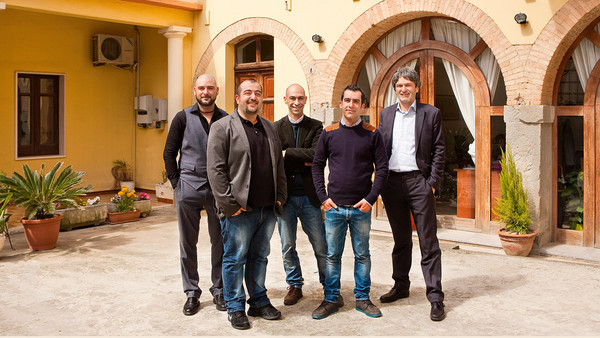
Sardex’s founders outside their office in Serramanna, Sardinia
©Alessandro Toscano

Sardex’s founders outside their office in Serramanna, Sardinia
Across the island of Sardinia there are more than 7,000 ancient towers built with large blocks of local stone. Known as nuraghi, they resemble giant beehives, jutting out across the landscape. Little is known about the nuraghi or their Bronze Age architects but almost every Sardinian I met had a theory about their purpose. Some told me that they were forts; others that they were residences, places of exchange, even communication beacons. “The amazing thing is that from every single nuragheyou see another nuraghe,” Carlo Mancosu, a 34-year-old Sardinian, told me. “Now imagine a system of communication with flames or light or mirrors. I think there existed a people in a network.”
It was this system, real or imagined, that inspired Mancosu and a group of childhood friends to found Sardinia’s first local currency: Sardex. Arts and humanities graduates with little financial experience, they built it from scratch in their home town of Serramanna as the island reeled from the financial crisis. Their hope was that the project would give them a job in the place where they had grown up. But six years later it has turned into a symbol of local action, spreading to create a new network of thousands of businesses. Together, they have traded nearly €31.3m in Sardex this year.
Serramanna sits just within the agricultural region of Medio Campidano, one of the poorest in Italy. When I visited, its piazza was full of old men drinking their coffee under the shade of Canary palms. Only the occasional roar of a jet engine from the nearby Nato base broke the silence. I met four of the currency’s five founders in their office, an old farmhouse in the town. On the wall was a sign in Sardinian and Italian: “Don’t complain.” Giuseppe Littera, another founder, told me that it was intended for his grandmother, who owns the farmhouse. “I love my grandmother [but] she’s still complaining about the Nato base because they took 10 plants from the best olive field their family had.”
Now in their early to mid-thirties, the founders all grew up together in Serramanna. “I have traced my ancestry back 500 years,” Giuseppe told me proudly. “They didn’t have earlier records.”
They seemed a remarkably disparate group, fiercely debating local politics and the financial crisis. Giuseppe speaks rapidly, moving between Italian and English. Gabriele, his younger brother, is more restrained, carefully balancing his words. Then there’s Mancosu, the most confident of the four. And Piero Sanna, a pragmatic amateur gold trader, whose financial experience initially set him apart from the others.
Life in their home town can seem idyllic, with its old church, public spaces and faded murals. But the four presented a different image. “Youth unemployment is at 50 per cent,” Giuseppe said. “The factories are in a state of crisis. Anyone with minimal linguistic abilities escapes to London or Berlin."
One of the stone towers, or 'nuraghi', found across the island
©Alessandro Toscano

One of the stone towers, or ‘nuraghi’, found across the island
In the 1960s, planners in Rome decided that the future of Sardinia — an island of miners, shepherds and farmers — lay in industrial production. Countless petrochemical plants, factories and refineries were built as part of the state-led Piano di rinascita (Plan for Rebirth). When I asked Sardex’s founders about the town’s problems, they would often repeat the phrase with a tinge of sarcasm. “Bring hell to paradise,” Mancosu said, “and they call it plan for rebirth.” The island’s nascent petrochemical industry, knocked off course by the 1973 Opec price rise, proved unable to compete in the international market. As the plants declined, thousands were laid off. “We had to face, year by year, an emergency in these industries,” said Stefano Usai, an economist at Crenos, a Sardinian research institute. “It is a heavy inheritance.”
Then, in 2008, another wave hit the island: the financial crisis. “Here, 2,000 miles away [from Lehman Brothers], banks stopped lending anything really,” Giuseppe told me. “People stopped going to ask for a loan.” Unable to secure credit, companies started to fold, swelling the ranks of the jobless. “In Serramanna we have a suicide problem.”
A Sardex agent
©Alessandro Toscano

A Sardex agent
At the heart of the financial crisis, explained Giuseppe, was a contradiction: its causes remained distant but its effects were local. “What does the economic system of Sardinia have to do with the mismanagement of Wall Street or London?” he said. The island’s companies still had the potential to produce goods and services; stock was sitting in warehouses and people were able to work. If this was a financial crisis, he began to think, then perhaps there was a financial solution. “There was no other option,” he said, “but to let companies create their own money.”
For at least 150 years, business people, utopians, social reformers and eccentrics have tried to introduce local currencies, often in response to money scarcity. Their creations have taken an array of different forms, such as credit systems, time banks or paper money, and ranged from the ingenious to the absurd. Many have been shortlived — but others have outlasted the conditions that brought them into existence.
Among the most successful is the Swiss WIR, which first appeared during the Great Depression. In 1934, a network of Swiss businesses decided to build a system of mutual credit allowing them to trade without relying wholly on the Swiss franc. The currency proved remarkably resilient, especially during periods of economic downturn. Although it has changed significantly since its inception, the WIR is still going strong and has about 45,000 members.
The office, a converted farmhouse
©Alessandro Toscano

The office, a converted farmhouse
“For his different purposes,” wrote the British economist EF Schumacher, “man needs many different structures, both small ones and large ones, some exclusive and some comprehensive.” For some, local currencies are a financial response to this human need and one that has a strong precedent through history. “The permanent feature of monetary systems in Europe throughout the period from Charlemagne to Napoleon — for a good millennium — [is] a distinction between different moneys for different purposes,” says Luca Fantacci, an economist and historian at Bocconi University in Milan.
Map: Sardinia in Italy
Sardex began as a small, unlikely idea while Giuseppe was a student in Leeds. In 2006 he read about WIR, the Swiss complementary currency, and became obsessed by the possibility of bringing something similar to Serramanna. “When I went to England and I was still studying, I was kind of trying very hard to find meaning in life. And when I discovered the WIR thing — that was like, OK, it’s a battle worth fighting. The other option is: let’s wait for systemic worldwide change.” He discussed the idea over Skype with Mancosu, Gabriele Littera, Sanna and Franco Contu, another founding member and friend, and they began designing a new local electronic currency whose name, Sardex, left no mystery as to its origins.
And so the group of arts students planned a new currency for their island. It seemed absurd: they had little financial or IT experience, no MBAs and no investor, only the outline of an idea. “We said: ‘We are here, the companies are here. [We can do this] without inconveniencing Brussels, Rome or New York,’” Giuseppe told me.
To build Sardex, they turned to financial history, drawing on studies of ancient credit systems, the Swiss WIR and John Maynard Keynes’s proposal for an International Clearing Union at Bretton Woods, a version of which was implemented as the European Payments Union (1950-58). There was logic in this approach; for if the financial crisis proved anything, it was that the history of finance is not linear. “There’s no reason to think that financial markets are more progressive than the financial institutions of the Renaissance,” says Massimo Amato, an economist and historian at Bocconi. “Common sense is never outdated.”
The Mulargia Lake in southern Sardinia
©Alessandro Toscano

The Mulargia Lake in southern Sardinia
While Sardex’s founders borrowed from history, they were not beholden to tradition. In a recent paper, Paolo Dini of the London School of Economics writes that, “Sardex has institutional characteristics that make it almost unique among the thousands of examples of CCs [complementary currencies] that have existed throughout human history and that still exist in almost every country in the world.”
To understand how Sardex works, you have to abandon much of what you may think you know about money. There is no bank that prints Sardex notes; no algorithm that generates Sardex digital coins. Instead, it functions as a system of mutual credit: each firm begins at zero, earning the digital currency — equivalent to but non-exchangeable with the euro — as it offers goods or services to others in the network. Companies may go into debt but only up to a certain limit, determined by what they can offer the other participating firms. Crucially, there is no interest on Sardex; it functions purely as a means of exchange. “[In the circuit] you have a debtor who does not see their debt increase but finds creditors who want to spend,” Gabriele told me. “This should be a natural part of the market.”
When Sardex was first explained to me, I found it easiest to think of it as a simple portrait of human relationships. “Money becomes information,” said Mancosu. “But, above all, money [here] is a system of rights and duties. From the moment that I take from a community — as is the case in Sardex — I am in debt towards that community; when I settle that debt with the community, I have given what I have received. It’s a beautiful thing.”
The founders, from left: Gabriele Littera, Piero Sanna, Carlo Mancuso, Giuseppe Littera and Franco Contu
©Alessandro Toscano

The founders, from left: Gabriele Littera, Piero Sanna, Carlo Mancuso, Giuseppe Littera and Franco Contu
The root of the word finance is the Latin finis, “end”. For Amato and Fantacci, the two Italian economic historians, Sardex’s simplicity reflects finance’s etymology and its true purpose: it allows a creditor and debtor to come together, make a payment and part ways, ending their relationship. Nothing could be further from the unsustainable repackaged debt, the system of delayed payments, which resulted in the collapse of the banking system in 2008. “[Sardex] is money that serves an end,” Giuseppe told me. “And once that end has been reached — it has done its work.”
At the heart of Sardex are its administrators. Using a centralised system, they carefully track member firms’ transactions, occasionally nudging the network to ensure its stability. Did they not, I wondered, resemble those central bankers from whom they had sought to distance themselves? “Sardex is voluntary,” Giuseppe replied. “We have no guns and we have no power.”
It proved easier to design Sardex’s system than persuade firms to adopt it. After registering the company in Serramanna in July 2009, the founders began to approach local businesses with their idea. As a group, they must have presented a curious sight: not one typically associated with financial professionals. Hundreds of firms in Sardinia rejected their proposals; after all, they needed euros to pay suppliers, not an invented currency overseen by a group of idealists. “It was a war,” recalled Mancosu. “They looked at us if we were from outer space.”
Then, at the beginning of 2010, the founders had a breakthrough: a local businessman, believing he was joining an established network, signed up. “We explained it to him,” recalled Mancosu. “And, for the first time, he said: ‘Great. That’s fantastic. Who else is in?’ ‘Just you,’ we said. ‘But we will grow.’ ”


Sardex: how does it work?
● Sardex is an electronic system of mutual credit for Sardinian companies. Lawyers, accountants, media companies, shops, hotels and utility companies all use it.
● To be eligible, a firm must have spare goods or services to offer to participating firms and be willing to make purchases within the network using Sardex.
● All firms begin with zero Sardex, earning the electronic currency as they transact with other members.
● Firms can go into Sardex debt but only up to a limit set by the administrators. No interest is charged on balances.
● Transactions of less than €1,000 must be carried out in Sardex. Larger transactions can use Sardex with euros.
● All transactions are tracked via a centralised system in Serramanna. VAT on transactions is paid in euros.
● Members are charged an annual fee according to size, ranging from €200 to €3,000.
And slowly Sardex did. High-street shops, hotels, media firms, accountants, dentists and restaurants all began to enter the network. By accepting payment in the currency, companies found that they could dispose of unused stock; cash-strapped firms could buy goods and services that they couldn’t otherwise afford. Lacking resources, the founders relied on charm, tenacity and, above all, their connection with the local area to persuade businesses to join. “Human relations have always been at the heart of our project,” Gabriele told me. “It has never been possible to sign up to the circuit via the internet.”
By the end of 2010, Sardex had a total of 237 members and a modest transaction volume of just over €300,000. It was still a struggle to survive, they recall. Initially the team relied on their families for support, later charging companies a small membership fee based on their size. And then, in 2011, they had a piece of luck: dPixel, a Milanese venture capital firm, intrigued by their idea, agreed to invest €150,000 in the company. “That was a real lifeline,” Giuseppe said.
 . . . 
Fifteen years ago, a retired law academic named Giacinto Auriti introduced his own paper money, the Simec, in Guardiagrele, a town in central Italy about the size of Serramanna. A wealthy man, Auriti paid a local printer to produce the currency, distributing it to locals from his own palazzo in exchange for lire. For Auriti, the Simec was not just a local initiative but a front in his long-running campaign against central banks and their monopoly on money production. “Between me and the central banks there is a mortal struggle,” he told The New York Times in 2001. “There is no middle way.”
Serramanna, where youth unemployment is high
©Alessandro Toscano

Serramanna, where youth unemployment is high
Unlike Auriti, Sardex’s founders have always viewed their currency as complementary to the financial system; they are not waging war against the Bank of Italy. State-issued money remains central to Sardex: firms in its network may combine euros and Sardex when making payments; taxes on Sardex transactions must be paid in euros; and the value of Sardex itself is tied to the euro. “We developed the network to be politically agnostic,” Giuseppe told me. “We talk to everybody: we don’t give a shit if you are from the left, the right, the north, the south.”
Auriti did not win his struggle against the Bank of Italy. In 2000 the Italian financial police, the Guardia di Finanza, shut down his experiment. But Sardex continues to grow. Today around 2,900 businesses are using it, including some of Sardinia’s most established organisations: Tiscali, the telecommunications company, and L’Unione Sarda, one of the island’s main newspapers. Stripped of money’s function as a store of wealth, Sardex has circulated quickly; according to the founders’ figures, it has facilitated more than €30m of transactions this year and about €84m since it started.


Timeline
April 2010: first Sardex transaction
Idea inspired by network of nuraghi
December 2010: 237 company members
2011: venture capital firm dPixel agrees investment
October 2012: €5m credit transactions
€31m traded in Sardex this year
€84m credit transactions facilitated since 2010
Trials under way throughout Italy
“In our circuit, one credit circulates 12 times in a year,” Gabriele said. “No one keeps their [Sardex] credits stuck in their wallet.”
The prize for Sardex is now Sardinia’s biggest employer: the state. The team is currently proposing a scheme whereby the island’s regional government could join the network, disposing of its spare capacity, such as bus tickets or leases on property. The deputy governor of Sardinia, Raffaele Paci, is an economist who seems to represent the opposite of these young arts graduates who were so distrustful of mainstream economic thinking. “If we live in an ideal world then we do not need Sardex,” he told me. But he recognised that in this imperfect world the currency had a role to play. “In general, it’s a good experience that is helping a lot.”
Some six years after it started, Sardex still faces challenges. In an imperfect market, the network must be pushed and pulled to maintain its stability, placing great responsibility and influence in the hands of its administrators. Then there’s the question of cheating. A system that relies on trust, Sardex allows companies to go into unsecured debt, exposing the network to the risk that a member may rack up a negative balance and walk away. In practice it’s happened a few times, said Giuseppe, and the team now has several claims lodged in Italy’s notoriously slow court system. “It is our last-resort scenario,” he told me.
After meeting Sardex’s team, I took a walk around Serramanna to speak with local businesses. The owner of a local store showed me her online Sardex account, indicating her balance and all the firms with whom she could potentially transact. She had sold lingerie to companies in the network, earning Sardex, which she then used to pay her accountant. “It’s ingenious,” she said. “It makes the money circulate here [and] doesn’t allow it to leave the island. It creates a connection.”
The model has already spread in Italy and there are reportedly trials under way to create local currencies in Veneto, Piedmont, Emilia Romagna, Marche, Lazio and Sicily. Last year Giuseppe travelled to Greece to share his knowledge with local currency organisers. Yet his advice to them was less about financial models, credit systems and software than relationships and trust. “Focus on the impact you can have, work every day . . . and try to build communities where there are none,” he told them. “[In Sardinia] the social fabric was destroyed. And we started knitting.”
Edward Posnett is working on ‘Harvest’, a book about commodities, trade and the natural world, to be published by Bodley Head/Viking Penguin, 2017
Photographs: Alessandro Toscano
Source: Dini, P, Van Der Graaf, S and Passani, A (2015). D2.3.d1: Socio-economic Framework for Bold Stakeholders, openlaws.eu deliverable, European Commission

Saturday, 20 June 2015

Anarchism, Russian-style

Kolions.jpg

The village of Kolionovo has a reputation for independent mindedness and upsetting the authorities. Now they’ve created their own currency - the koliony.


The story of Russian farmer Mikhail Shlyapnikov and his 'self-made' money has become something of a sensation of late, and has long travelled beyond the confines of Kolionovo, the village where he lives. The Moscow Prosecutor's Office is now investigating Shlyapnikov's currency (named koliony after his village) and its creator on suspicion of infringing the state's monopoly on issuing currency.
Mikhail Shlyapnikov with supporters in the town of Kolionovo.
Mikhail Shlyapnikov with supporters in the town of Kolionovo. via michael-077.livejournal.com
A remote and tiny village, Kolionovo lies at the end of a small road just off a highway leading west out of the Russian capital. And Kolionovo would have remained remote, tiny and unknown, if it wasn't for the periodic scandal about how the village's elderly residents have chased the local administration out of town, the campaign to save the village hospital, the self-organised firefighting service or the ban on public officials entering the village without a document testifying to their mental health and a recent fluorography test for tuberculosis. But now the residents of Kolionovo have devised their own currency and, in doing so, have written themselves into a wider history – a history of alternative currency and anarchism. 

Existential downshifting

With the dubious honour of being Russia's leading anarchist farmer, Mikhail Shlyapnikov was a successful entrepreneur before he moved to Kolionovo.
After a series of unsuccessful operations for cancer in 2004, however, doctors told Shlyapnikov he had three months to live. And Shlyapnikov decided that, if he were going to die, he'd die in the countryside.
This existential downshifting did not help Shlyapnikov find peace. Instead, the move to Kolionovo prompted Shlyapnikov to become something of a rebel. This kind of story usually takes place in reverse: a former activist, having come of age (and to his or her senses), moves to the countryside in order to escape the madness of city life. After living for a while in Kolionovo, though, Shlyapnikov began to invest his entrepreneurial talents in what he understands by anarchism.
The move to Kolionovo prompted Shlyapnikov to become something of a rebel.
For instance, take Kolionovo's sapling nursery, a form of ecological activism and business vital to the health of the Moscow region: the forests here suffered huge fires in 2010 and after; and have been punished by an epidemic of insects, which feed on tree bark.
But now Shlyapnikov and his comrades have gone too far (for the authorities that is): they have started issuing their own promissory notes; 20,000 of them. And with his charisma and popularity, Shlyapnikov couldn't help but provoke the powers that be.
After all, the question on everybody's lips – in the break room at work, hanging out with friends or chatting on the internet – is the exchange rate. So one can understand the Russian state's concern for its currency monopoly, as well as the press and public reaction to the koliony
Koliony: the alternative currency Shlyapnikov has printed.
Koliony: the alternative currency Shlyapnikov has printed. via kobilanskaia.livejournal.com
Minimise interactions with the state, develop mutually beneficial relationships and good old-fashioned altruism (helping the less well-off, orphans): this is anarchism, Kolionovo-style. This is not total anarchy, however: Shlyapnikov is still paying his workers in roubles, and paying employer taxes.

Systems of exchange

We're used to measuring so much in terms of money, it's hard to think of life without it. 
But there are a large variety of currency systems, which depart from the fiat system (that is, money issued by the government): time banks, crypto-currencies (bitcoins being the most famous), local currencies and currencies with 'return percentage' or planned inflation, goods-exchange communities such as LETS (local exchange trading system) and internet exchange communities.
The range of different forms of economic relations is striking. According to Maxim Mitusov, an economist who specialises in local currencies, there are more than 4,000 local economic systems in the world. 
In essence, any group, which is united by common interests and mutual trust can create its own money or its own non-monetary system of exchange with only a few simple skills. It's a question of how united the group is – that's the deciding factor.
It's a question of how united the group is – that's the deciding factor.
Early societies did not suffer from the absence of money at all: they simply weren't aware of it. Evidence for this can be found in numerous observations made by ethnographers and social anthropologists.
First of all, primitive societies originally found and consumed all goods together, collectively. Second, most primitive forms of ethics were based on mutual assistance: you simply couldn't survive without it. This kind of ethics excludes any form of selfishness, the desire for profit – even the very idea of debt.
Self-organised economic activity rises to the fore when fiat currencies begin to decline. During the 1990s, many Russians working in factories remember being paid in the goods they produced themselves, or the goods they were traded for. (Army families can recall how entire garrisons were paid in groceries.) The money just wasn't there, but goods were aplenty.
For people living in the Russian countryside, barter is still an important mechanism in interpersonal relationships. Financial flows simply can't penetrate this far, and remain in the metropole – in banks, the cycle of urban consumption, in offshore accounts, and in bureaucratic and criminal structures. 

Self-help

Crises are often accompanied by attempts to create money without the involvement of the state. The crisis, which hit Argentina in 1998, for instance, provoked an unprecedented level of cooperative activity.
Cast out from the closed factories and rented flats, Argentinе citizens watched with hungry eyes how trains and trucks carried off basic items – items which they needed – in order to pay off the state's foreign debt. At that moment, millions of people without jobs realised that the only things you can rely on in life are your own energies, skills, and other people.
Looking at photographs from that time, you can see, not only people holding stolen goods, molotov cocktails, sticks and stones, banners, but brightly coloured bits of paper too – money they'd made themselves, the credito. With the help of this 'money', members of a rebellious and self-organised community were able to pay one another and exchange goods. 
Or the example of Michael Unterguggenberger, mayor of the Austrian town of Wörgl, who issued his own Wörgler Freigeld to save the town from bankruptcy and build a series of public projects over a 13-month period during the Great Depression. After a few years, though, when dozens of other Austrian communities had become jealous of their neighbour's success and decided to replicate the idea, the national bank banned the Freigeld, frightened by the threat to its monopoly. 
Likewise, the Bashkirian sovkhoz (state farm) of Shaimuratova responded to the financial crisis of 2008 by issuing its own currency – shaimuratiki. According to the project's initiator, economist Rustam Davletbaev, local currencies can channel unexpressed 'demand' (usually ignored by the market) in the sense that it allows people who want to buy goods (but have no money) to use their own goods or skills in a local system of exchange. 
Unfortunately, though, while everyone in Shaimuratovo liked the idea, the local Prosecutor's Office didn't. The fight for shaimuratiki continues, only now at various courts. 
What is the secret of these and hundreds of other currencies just like them? What makes them workable, and how do they affect the economy? 
On the one hand, alternative currencies are more than just money: they connect people's real interests to their capabilities and the products of their labour. As a rule, these kinds of currencies are not part of the system of financial speculation, nor are they linked to the price of hydrocarbons.
On the other, the cost of devaluation (demurrage) of alternative currency means that accumulating this money is less than profitable. Yet circulation of these currencies is increasing, and is leading to the development of local infrastructure.
If alternative currencies are so useful, why is the state afraid of them? 

'Like a piece of uncurrent gold'

'Pray God, your voice, like a piece of uncurrent gold, be not cracked within the ring.' So speaks Hamlet in an elegant reference to the death of the king, the father of the Danish prince, and whose face was depicted on the 'piece of uncurrent gold'. 
Shakespeare's metaphor exposes one of money's most important characteristics: while the fact that monarchs impress themselves on every unit of currency may seem an act of vanity, the face of the sovereign means that the value of this unit is guaranteed by the state.
For instance, the anthropologist Keith Hart writes: 'Look at a coin from your pocket. On one side is “heads” – the symbol of the political authority, which minted the coin; on the other side is “tails” – the precise specification of the amount the coin is worth as payment in exchange. One side reminds us that states underwrite currencies and the money is originally a relation between persons in society, a token perhaps. The other reveals the coin as a thing, capable of entering into definite relations with other things.'
The nominal value of every coin often did not correspond to the value of the metal (gold, silver or bronze) used to make it. In Information, Work and Value, Paul Cockshott goes back to the very first currency made in the Kingdom of Lydia (coined from a mixture of gold and silver). Diluted with silver, these seventh century coins were worth more than the gold contained within them, and were, as such, very expensive coins. With a single Lydian stater, you could satisfy your basic needs for a month.
Cockshott comes to the conclusion that ancient kings tried to avoid deceiving their subjects, and both introduced and set the value of their currency specifically to simplify the collection of taxes: 'If the Crown imposes on its citizens a duty to pay tax in coin of the realm, then these citizens must either work directly for the state – building roads, acting as soldiers etc, or, they must produce commodities to sell to those who do serve in the army, build roads etc. In this conception, it is the coercive power of the state that accelerates the penetration commodity production into the social organism.'
Today, it is the currencies of the world's most powerful states, which are the most respected. (In this sense, the Eurozone is like an empire created and managed by the unity of economic interests.) And today, the state's main concern in the financial sphere is to preserve its status, its monopoly on issuing money. 
The state's main concern in the financial sphere is to preserve its status, its monopoly on issuing money.

'Koliony aren't even money, they're just IOUs.'

As Mikhail Shlyapnikov has argued in court and out (he has his own LiveJournal account): 'Koliony aren't even money, they're just IOUs.' In this sense, this farmer-cum-anarchist from outside Moscow has not come up with anything new.
In Debt: The first 5,000 years, David Graeber writes: 'There is an unresolved debate between those who see money as a commodity and those who see it as an IOU. Which one is it? By now, the answer should be obvious: it's both.' 
Graeber uses numerous examples to illustrate how traders and artisans in the past issued their own money made from iron, wood and leather. This kind of money circulated in a community of business partners, among consumers of the same institutions, stalls and studios. And as we face a fresh economic crisis, small business owners have returned to these practices. 
This development is neither surprising, nor revolutionary. Small business is creating currency in its own image – and now you can travel down the 'goods-money-goods' trail without the involvement or management of the central bank. Big capital expresses itself through fiat currencies and comes alive in global currencies – even abstract ones like electronic currencies. 
But IOUs are goods like any other, and the exchange of goods is, in turn, a mutual obligation. According to Graeber, economics is, in fact, the material expression of ethics, and the market economy is a reflection of the ethics of debt. But where is the border that separates 'mutual obligations' from the cut-throat world of financial monopolies? 
It was the German economist Silvio Gesell who first detailed both the useful and harmful aspects of money at the end of the 19th century. Indeed, it was Gesell's concept of 'free' money, which inspired the experiments in Wörgl and Shaimuratovo. 
For Gesell, money can help people find a common economic language, to recognise people's contributions to society. But money also breeds a tendency to accumulation, which creates hierarchies, competition, crises and armed conflict. Gesell saw the basis of prosperity and justice in making accumulation unprofitable and, on a conceptual level at least, tried to think about money as an item of exchange like any other.
But we have to make sure that goods and money correspond in terms of value, and all goods have an expiry date. So why shouldn't money? Demurrage is precisely that: the ageing of money. 

Yin and yang

The Belgian economist Bernard Lietaer classified the world's currencies in terms of Yin and Yang. Yang currencies are the fiat currencies we know (and love) – units of value issued by the state. They are convenient for international exchange (if the issuing state is sufficiently powerful). They are capable of gathering society's resources for large projects and quick mobilisation. But they also form the basis of hierarchy, power and competition. 
By contrast, Yin currencies stimulate the circulation of locally produced goods and services, transforming the whole landscape of a community through constant circulation.
Lietaer says directly that the more patriarchal a society is, the less perfect the financial system it creates. The men standing at the top of the patriarchal hierarchy do not allow 'currency pluralism' because it erodes centralised control (hence the concern in the Moscow and Bashkirian Prosecutor's Offices). 
Those ancient societies, which respected women's reproductive labour, which idealised it and connected it to fertility cults – these societies were more ready for cooperation. For Lietaer, this is the source of currency pluralism:
'The stronger the king, the larger the kingdom, and the less practical it becomes to keep the demurrage system going. This happens in parallel with a growing political necessity for a repression of women as well. The stronger the patriarchal impulse, the more it may appear necessary to give to each man the feeling of being “king in his own household”.' 
While patriarchal societies favour strong single currencies, matriarchal societies opt for dual currency systems – one currency for long-distance trade, and another for local exchange.
While patriarchal societies favour strong single currencies, matriarchal societies opt for dual currency systems

It's time to change

Mikhail Shlyapnikov and his kolionystill have a long way to go before they make it into the history books. The humble kolion is, after all, not subject to demurrage. But the connection between this farmer and the land around him makes him a part of a larger financial history of alternative currencies.
The kolion is the strongest currency: its exchange rate is unchangeable and fixed to eggs, geese and other goods produced by Shlyapnikov. Oil prices and the rouble exchange rate can affect the kolion indirectly via the prosperity of the participants of exchange. But there is no direct link. And the significance ofkoliony lies in creating autonomy from the harmful system of speculation. 
As Rustam Davletbaev, the creator of shaimuratikiwrites: 'Koliony have exposed a very serious problem – the absence of responsibility of economic institutions of the state – the Central Bank, Ministry of Finance and the Ministry of Economic Development when it comes to the periodic economic and financial crises faced by Russia, and their consequences.’
To put it simply: if the Central Bank is responsible for economic growth, then why does it shrug off negative currency fluctuation, aspects of crisis and a fall in GDP so easily? Why does no one take responsibility for the fall in citizens' living standards? Why do these structures fail to provide the conditions necessary for our citizens to implement their rights to life and work? Perhaps it's time to change something?'
The pathos of that 'it's time to change' should give us reason for optimism. Just like Shlyapnikov, Davletbaev understands all too well the indifference of those 'responsible' for the state of affairs in a remote village.
If one looks at the Russian economy today through the eyes of Silvio Gesell, there is nothing sadder than the total control of people who receive profits from rents rather than labour and real exchange.
This is why we should give the creators of the koliony and shaimuratiki their due, and those who try to spread the seeds of cooperation and economic alternatives on (otherwise infertile) Russian soil.
Source: https://opendemocracy.net/od-russia/daniil-dugum/anarchism-russianstyle

Tuesday, 9 June 2015

The innovators: the Bristol pound is giving sterling a run for its money

The success of the community currency – with the equivalent of £700,000 in circulation – has put the spotlight on attempts to keep money in local economies

When his firm was going up against national companies for contracts to manage waste, Jon Free needed an edge to win the pitches. The answer he found was in the sense of community that existed among small businesses like his.
By using his local currency, the Bristol pound, he saw companies were more willing to give their business to him and keep money flowing in the area. Launched almost three years ago, the community currency aims to keep money circulating among independent retailers and firms by encouraging people to use the local ‘cash’ instead of sterling, an idea that has inspired other towns and cities to take up similar schemes in the UK and abroad.
“To be able to drop in and create a link to make [the money] a circular thing is a big part of it,” the managing director of Waste Source said. “To say that we are registered with the Bristol pound shows that we are more community based.”
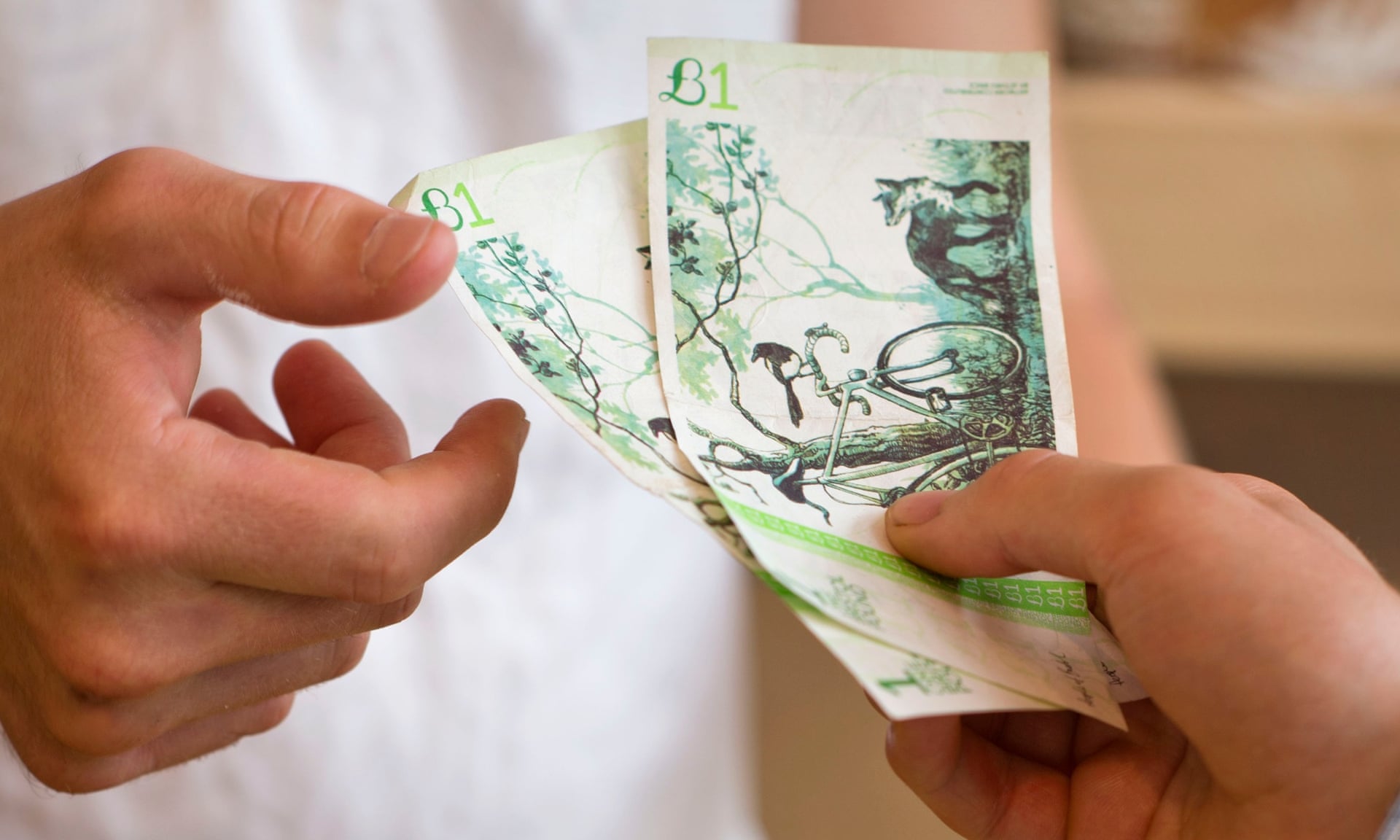
In use since 2012, the system operates as both notes and in electronic form with each Bristol pound equal to one pound sterling. Some 800 businesses in theBristol area now use the community currency, with coffees, meals, council tax and even pole-dancing lessons paid for with it.
“The practical vision was to get something which would connect local communities with their businesses in a way which kept money building up in their local communities,” the currency’s co-founder, Ciaran Mundy, said. “What happens is that if you spend it at a large supermarket chain, 80% of that will exit the economy very quickly.”
The East Bristol Bakery accepts the Bristol pound.
 The East Bristol Bakery accepts the Bristol pound
While community currencies have a history going back to Victorian times, there has been a resurgence in recent years, with Bristol emerging as the standard-bearer in the UK.
The system works by people exchanging their sterling for paper Bristol pounds – in single, five, 10 and 20 denominations – or by opening an account at the Bristol Credit Union. The currency can then be spent in participating businesses, or between businesses, in return for goods or services.
So far, some £1m has been issued in the community currency, according to Mundy, of which about £700,000 is still in circulation. As it is a voluntary scheme, the currency can switch between sterling and Bristol pounds, he said.
The thinking behind the creation of the new currency, said Mundy, was to make a minor change to allow for more money to be spent in local areas.
“I was looking for a technological and cultural innovation which allows people to conduct themselves in a way which is more sustainable. A big part of that is being aware of the impact of your economic activity,” he said.
The paper notes are non-redeemable vouchers that expire and can only be spent with traders who will take them, but can’t be swapped for cash at a bank. The digital currency is regulated like sterling and is treated in a similar way in accounts.
“If you know, when you spend money – whatever form it is in – the impact that it is going to have because you know the people that you are spending it with, and you know the people that they are going to be spending it with, you are aware of the circumstances of the economy that surrounds you; it is a more transparent economy.”
The results of the community-oriented approach to money exchange is particularly evident in the city’s restaurant sector where local growers who sell to local restaurants use the Bristol pound, said Mundy. The mayor of the city, George Ferguson, takes all of his salary in Bristol pounds.
Which businesses can use it are dictated by a few broad rules. First, the business has to be in the area. Second, they cannot be listed on the stock exchange.
“The criteria is: if you are mostly locally owned by people who live in the area. We have a postcode map drawn around the boundaries of where you can join the Bristol Credit Union – that area is about one million people,” said Mundy. One large supermarket chain and other high street retailers, as well as a budget airline, have asked to be included in the Bristol pound scheme but were turned down, he added.
The success in Bristol has led to similar schemes in other parts of the country, with 25 communities working on likeminded projects, including one in Liverpool. The ambition in Bristol, says Mundy, was to alter the financial system very slightly so that it works in favour of local business: “Over the course of time you end up with some kind of fair and ecologically minded economy … and a more localised economy,” he said.
The Exeter pound is expected to launch at the beginning of September. Ian Martin, one of the organisers, said they hope to have 100 retailers using it at launch, initially using paper and then, later, digital transactions.
“This sterling-backed model is very simple. It is simple because it appears on notes and it appears digitally,” he said. “Younger people tend to work digitally and older people tend to work with the notes but you need both to make it real. The advantage of the notes is that each piece is a local flyer, it makes it feel real to people but also it popularises it.”
The amount of money circulating in Bristol is still at a low level, although a local architects firm have recently billed the council for 900,000 Bristol pounds. Similar large-scale deals of the currency would see it blossom, said Mundy. “If we can get that type of procurement going, then we will have a very serious impact on the local economy and that is when we will see structural economic changes,” he said.
Jon Free’s company cannot spend the currency with any of its suppliers so instead found another outlet for it: “We booked our Christmas do in December with a restaurant that accepted that and paid them in full for the evening, and that cleared a fair amount,” he said.

Barcelona takes on the idea

A coalition of leftwing parties in Barcelona has taken inspiration from the Bristol model to propose a similar currency in the Spanish city. Also intended to benefit small and medium-sized companies, the organisers want to pay some salaries and benefits with the community currency and allow local taxes to be paid with it.
Link: http://www.theguardian.com/business/2015/jun/07/the-innovators-the-bristol-pound-is-giving-sterling-a-run-for-its-money#comment-53465534