Showing posts with label Monetary System. Show all posts

Monday, 22 August 2016

Court of Genoa: technical assessment on the creation of bank money


In the Italian Civil Court of Genoa, on August 18, 2016, there was a hearing in the case on the failure to take account of the creation of money by Banca Carige.  


The Carige attorney is Paolo CANEPA (brother of the magistrate Anna CANEPA, the "Magistratura Democratica" union secretary), from the law firm ROPPO & CANEPA, who had attended DE BENEDETTI in the case of the LODO MONDADORI against Silvio BERLUSCONI, the former Italian PM. 

The lawyer asked that the case be estopped for total groundlessness, invoking the temerity of the counterparty. The Court refers to the next hearing, October 4, 2016 at 10.15 AM, ahead of Hon. Luigi COSTANZO, President of the Chamber as well as Deputy Chairman of the Court, to decide on the appointment of a forensic accounting expert.

  The lawyer Marco DELLA LUNA, representing the plaintiff, constituted by a British financial company and Marco SABA, argues that the emergence of the revenues from the creation of money by commercial banks, in the case of CARIGE more than euro 25 billion, as well as to rehabilitation of the Italian banking system, would lead - through subsequent taxation - to the safety of the Italian state budget.
  
A question arises: if everything is in order, why the management of the Genoa bank CARIGE is opposed to the inquiry ?

Source: http://leconomistamascherato.blogspot.co.uk/2016/08/court-of-genoa-technical-assessment-on.html

Tuesday, 24 May 2016

The Ecology of Money: Debt, Growth, and Sustainability


"Modern economics must 'grow' because money borrowed for investment can be repaid only by expanding production and consumption to meet the burden of usurious rates of interest. The roots of this dynamic between debt and growth lay in the financial revolution of the late seventeenth and early eighteenth centuries in Britain, which establish a new usurious monetary system.

"For the first time in history credit was made widely available, but only on condition of an exponentially increasing debt burden. To pay back debts, production had to increase correspondingly, leading to the industrial revolution, economic 'growth,' and modernity itself. Though private creditors grained a monopoly over the creation of credit, and were disproportionately enriched, the resulting economic growth for a time was great enough to benefit most debtors as well as creditors, ensuring widespread prosperity.

"That is no longer the case. With today's eco-crisis we have reached the limits of growth. We no longer have the natural resources to grow fast enough to pay our debts. This is the real root of our current financial crisis. If we are to live sustainably, our system of money and credit must be transformed. We need a non-usurious monetary system appropriate to a steady-state economy, with capital broadly distributed at non-usurious rates of interest. Such a system was developed by an early nineteenth-century American thinker, Edward Kellogg, and is explored here in depth. His work inspired the populist movement and remains more relevant than ever as a viable alternative to a financial system we can no longer afford." 

--  from the blurb on the back cover of The Ecology of Money

The Ecology of Money was published by Lexington Books in 2013 and is available at Amazon.com  

A Summary of the Argument of The Ecology of Money in 10 Points:

1. Our ecological crisis is a consequence of the productive effort we must make to meet the demands of our financial system. This crisis is upon us since we no longer have the natural resources to sustain this effort.  

2. The roots of this financial-economic dynamic lie in the financial revolution of the seventeenth and eighteenth centuries in Holland and England, where credit and finance as we know them were invented.

3. Unfortunately, this financial revolution as completed in England: a) privatized credit, giving bankers a legal monopoly over money creation through issuing loans; b) created a national debt and a central bank to backstop private lending; and c) allowed bankers to charge high (usurious) rates of interest on loans. The Bank of England became the symbol of this "English system," as Alexander Hamilton called it, which was subsequently exported to America and most of the modern world. American populists called it "the money power."

4. Once key sectors of the economy came to depend on money borrowed at usurious rates of interest, it became necessary to keep expanding economic output. The obligation to repay such debts is what forced modern economies into endless "growth." Traditional, steady-state, reciprocal, sustainable economies were displaced by economies relentlessly seeking out new markets, technologies, resources, and laborers, and the industrial revolution -- and what we call "modernity" -- was born.

5. More than two centuries of economic "growth" have given us the miracle of the modern world, with all its astounding wealth and technology. That miracle has also exhausted our planet, which now staggers under the cumulative effects of resource depletion, pollution, overpopulation, and climate change. Insofar as the limits to growth have been reached, we can no longer hope to repay our debts, as in the past, by growing our way out of the crisis. 

6. Our "too big to fail" financial system has succeeded in transferring much of this excessive debt onto taxpayers, postponing and likely intensifying the final reckoning. We are further burdened by a dysfunctional political system -- largely corrupted by the same financial interests -- which is less and less responsive to the urgency of reform, which may now be impossible. 

7. The now inter-woven ecological and financial crisis is likely to play itself out no matter what we do. If so, the survivors will need to adjust to a dramatic downsizing and a return to sustainable economic practices. If civilization survives, it will need a financial system compatible with a steady-state, non-growth economy. 

8. The outlines of such a system actually exist: they were developed by a nineteenth-century American financial theorist, Edward Kellogg. He proposed a decentralized system of public banking, where citizens could borrow on good collateral at a non-usurious rate of interest fixed by law at one percent. Kellogg's system, which inspired American populists, is a model for financing a future sustainable economy.

9. To say that we can no longer tolerate exponential growth as we have known it is not to say that human ingenuity has no future, that profound innovations in human life are no longer possible, or that the vast store of scientific and technical knowledge born of the industrial revolution cannot be adapted to new circumstances. A sustainable, steady-state economy is not necessarily a static or primitive economy, though likely it will be a far more modest and prudent one.

10. Our immediate prospects, however, remain daunting. Human history has long swung between extremes -- boom and bust, feast and famine, peace and war, the rise and fall of civilizations -- and we have no reason to believe our era is exempt from that ancient dynamic. We are a resilient species, and the silver lining of any crisis has always been the opportunity to learn from our mistakes, an opportunity perhaps not otherwise possible. Let's make the best of it.

Tuesday, 17 May 2016

What's Wrong with Our Monetary System and How to Fix It


by Adrian Kuzminski

Something's profoundly wrong with our global financial system. Pope Francis is only the latest to raise the alarm:

“Human beings and nature must not be at the service of money. Let us say no to an economy of exclusion and inequality, where money rules, rather than service. That economy kills. That economy excludes. That economy destroys Mother Earth.”

What the Pope calls “an economy of exclusion and inequality, where money rules” is widely evident. What is not so clear is how we got into this situation, and what to do about it.

Most people take our monetary system for granted, and are shocked to learn that the government doesn't issue our money. Almost all of it is created by loans made “out of thin air” as bookkeeping entries by private banks. For this sleight-of-hand, they charge interest, making a tidy profit for doing essentially nothing. The currency printed by the government – coins and bills – is a negligible amount by comparison.

The idea of giving private banks a monopoly over money creation goes back to seventeenth century England. The British government, in a Faustian bargain, agreed to allow a group of private bankers to assume the national debt as collateral for the issuance of loans, confident that the state would be able to service the debt on the backs of taxpayers.

And so it has been ever since. Alexander Hamilton much admired this scheme, which he called “the English system,” and he and his successors were finally able to establish it in the United States, and subsequently most of the world.

But money is too important to be left to the bankers. There is no good reason to give any private group a lucrative monopoly over the creation of money; money creation should be the public service most people mistakenly believe it to be. Further, privatized money creation allows a few large banks and financial institutions not only to profit by simply making bookkeeping entries, but to direct overall investment in the economy to their corporate cronies, not the public at large. 

Ordinary people can get the financing they need only on burdensome if not ruinous terms, leaving them as debt peons weighed down by mortgages, student loans, auto loans, credit card balances, etc. The interest payments extracted from these loans feed the private investment machine of Wall Street finance, represented by the ultimate creditor class: the notorious “one percenters.”

There are two main critics of our privatized financial system: goldbugs and public banking advocates. The goldbugs would return us to a gold standard, making gold our currency. The problem is that it would become almost impossible to borrow money since the amount of gold which could be put into circulation is relatively miniscule and inelastic. They is no way easily to expand the supply of gold in the world

Credit—the ability to borrow money—is vital to any economy. If we cannot borrow against the future for capital investment—roads and infrastructure, housing, businesses, hospitals, education, etc.—then we cannot fund essential services. To that end, we need an elastic money supply.

Public banking advocates—like Stephen Zarlenga and Ellen Brown--appreciate the need for credit. Their aim is to transfer the monopoly on the creation of credit from private to public hands. Unfortunately, there is no guarantee that this form of "progressive" state finance would be any better than private finance. 

If we had a truly democratic government actually accountable to the public, such a system might work. But in fact governments in the United States and most developed countries are oligarchies controlled by special interests. A centralized public bank—without a political revolution--would likely favor government contractors and continue to squeeze borrowers for interest payments, now supposedly directed to “the public good.” 

This is curiously reminiscent of the system in the old Soviet Union and today's China, where a political nomenklatura ends up calling the shots and enriching itself. Our current system of centralized private finance, as well as the "progressive" proposal of centralized public finance, are no more than twin versions of top-down financial control by an elite. 

Fortunately, there is another model available. There is a long tradition in America, beginning with colonial resistance to “the English system,” and continuing with anti-federalists, Jeffersonians, Jacksonians, and post-Civil war populists. This tradition opposed any kind of centralized banking in favor of some kind of decentralized issuance of money. 

The idea they developed is to prohibit any kind of central bank—public or private—and instead have money issued exclusively locally on the basis of good collateral to individuals and businesses. It's a grassroots, ground-up approach. Priority is given to local citizens and businesses, who can get interest-free loans from local public credit banks to finance what they need to do.

Such a system would have to be publicly regulated to ensure fair and uniform standards of lending at the local level. It would, in that sense, be a public banking system. The absence of a centralized issuing authority, however, would prevent any concentration of financial power, public or private. 

Any top-down system of financial control—private or public—presupposes some kind of control by elites, that is, some kind of central planning, whether in corporate board rooms or in the offices of government agencies, or some combination of both. The historical record suggests that such top-down decision-making is inevitably self-serving, distorted, and socially counter-productive. 

Indeed, whether public or private, it is the love of money empowered by centralized finance which creates the “economy of exclusion and inequality” which Pope Francis decries.

The decentralized system of populist finance would operate with no central planning. Instead, countless local decisions about lending and credit-worthiness would function as a genuine “hidden hand” of finance, one which would be self-regulating. Here the love of money would find no way to leverage its power. Instead it would be dispersed among the general population, as it should be, without burdensome interest charges, to the benefit of all.

Adrian Kuzminski lives on a farm in upstate New York and is the author of The Ecology of Money: Debt, Growth and Sustainability and Fixing the System: A History of Populism, Ancient & Modern, among other works.


Since my brief comments on the gold standard seemed most provoking, let me add this update to my article, "What's Wrong with Our Monetary System . . ."

When people talk about the gold standard they usually mean defining money in terms of some fixed quantity of the stuff. At one time, for instance, the US government guaranteed that $35 would buy you a troy ounce of gold.

That's not a pure gold standard, but one in which gold is mixed up with paper money, that is, bills, certificates, or other so-called token guarantees whose ratio to gold is supposed to be fixed, but which historically has in fact fluctuated wildly.

A pure gold standard would be one in which only gold coins circulated as currency, with no piggy-backing paper money or other so-called token guarantees redeemable in gold available.

Until the invention of credit on a large scale in the seventeenth and eighteenth centuries, that was basically the case. Most Western economies at that time relied on gold and/or other precious metal coins, and little else, for their currency. If there was ever a pure gold standard, that was it.

Gold coins were the basic medium of exchange. Silver and other portable valuables were also used, but let's stick to gold for the sake of simplicity. The key point is that all such items all had an intrinsic value; we can call them commodity monies.

Most exchanges were therefore reciprocal, that is, equal value for equal value. Since gold has an intrinsic value, its exchange for a product or service fully satisfied any transaction. This is in contrast to an exchange based on debt, or a promise to pay, which is not immediately satisfied, but deferred.

Such credit as was available locally for most people back then was relatively short term or seasonal, say in advance of the next harvest. Such promises were often recorded, but did not circulate as a medium among third parties, that is, they were not yet money.

More extended forms of credit certainly existed—most notably the bills of exchange of merchants—and they were important, particularly in long-distance trade for luxuries and some basic commodities (grain, salt, etc.). But they were specialized and limited in scope. Usury was widely condemned, making lending even less attractive to anyone with money. Savers tended to be hoarders.

It is difficult to create credit with a commodity currency like this because money has to be lent out almost entirely from existing savings. The money supply, as a result, was highly inelastic; it could expand only in the event of significant new discoveries of precious metal reserves. 

Indeed, it was only the discovery of vast gold reserves in the New World which allowed the gold-based money supply to expand. This permitted new investment in commerce, and helped fuel the expansion of trade and manufacturing we associate with the rise of early Modern Europe. 

But credit, still tied to gold, remained hard to get, and the bulk of early modern economies remained on a largely local and subsistence level. It was the goldsmiths of seventeenth century England who were among the first to figure out how to get around the inelasticity of gold and commodity monies. 

They discovered that only a relatively few depositors would claim their gold at any one time; as a result they found they could lend out far more to borrowers—in the form of certificates redeemable in gold--than the amount of deposits they actually had on hand, and that they could get away with it (most of the time).

This multiplication of credit through what we now call fractional reserve banking, along with other credit innovations in what some call the financial revolution of the late seventeenth and early eighteenth centuries, made it possible to fund economic growth far beyond what a pure gold standard would allow. 

The key thing was the substitution of various tokens purportedly redeemable in gold for gold itself. At that point gold became identified with and highly leveraged by these various new financial tokens, which were ever less tethered to their gold base.

The so-called classical era of the gold standard—even at its height between 1870 and 1914—was not a pure gold standard at all, but one enormously amplified by credit instruments pyramided on top of gold reserves. 

When we talk about the gold standard in modern times, we are really talking about a series of financial instruments—fractional reserve banking, a national debt, central banks, securities markets, usurious interest, etc.—which created a ballooning pyramid of tokens merely representing gold. 

The final, long-delayed collapse of the largely symbolic modern gold standard during the Depression, confirmed by Nixon's removal of the United States from any last link to gold in 1971, made official what was already plain: that most money had in fact long been issued as debt, with less and less significant backing by any precious metals.

In this light, it isn't hard to see what the call for a return to any sort of gold standard really means. In its pure form, it means the return to a highly inelastic money supply, last seen in the Middle Ages. I don't think that's what goldbugs have in mind, though it might be where we end up in a severe post-collapse scenario.

Otherwise, it means a mostly symbolic link to a precious metal, no doubt psychologically satisfying to some, but unfortunately little more than a convenient obfuscation to the powers that be for how the monetary system, which is killing us, really works. I don't think that's what the goldbugs want either.

(For anyone interested, this and related issues are discussed at length in my book, The Ecology of Money: Debt, Growth, and Sustainability.)

Source: http://cluborlov.blogspot.co.uk/2015/07/whats-wrong-with-our-monetary-system.html 

Sunday, 1 May 2016

Bank accounting and Money creation - The Rabbit in the hat BOOK


The Rabbit in the hat – bank accounting and money creation, wants to be a book that puts order in the topic, perhaps the first exclusively dedicated to the subject, at least in Italian. However, it is the first text to have a comprehensive analysis of all aspects of the creation of bank money, from accounting to legal ones, and the individual movements of money on the bank balance sheet in order to reconstruct, accurately, each accounting entry that allows banks not only to create their own means of payment to be used in the economy, but also to keep it in order to take advantage of monopoly situations.

The rabbit in the hat, in the title, wants precisely describe a sort of magician's trick, with which the banking system is able to produce an asset out of nothing without any business cycle. The money creation process is described in the preliminary analysis, in all the elements, from the contiguity between legal and bank money, to the accounting standards, reported and commented in a long chapter, passing by the inter-bank payments and clearing houses, where the trick of the magician acts before to put back the bank money in the balance sheet without destroying it. Attention is also given to "off balance sheet operations", a place outside the rules, where transit some monetary volumes largest of those shown in the financial statements, and to the reserves in liabilities, where the banks' owners can collect their shares.
A book that wants to be analytical but also help with the solution proposed by the various monetary reform movements.

Daniele Pace is a writer and independent researcher, has always been involved in the theme staunch supporter of the legal means of money.
In 2012 he published "The Utopian Money" by offering a future vision of free money from the debt and the Central Powers. He then wrote the comic book "Dialogues with Auriti" in 2014, for a disclosure in the simplest form on the theory of the ownership of money.
In 2015 it is the publication of "The Fruiterer Conspiracy", logical and critical analysis of the Quantitative Theory of Money that would, from about 3 centuries, inflation linked to the money supply, without any empirical evidence.

In Italy is a speaker at many conferences, as well as having the informational space in the web TV Salvo5puntozero.

Table of Contents
PREFACE

FIRST PART
PRELIMINARY ANALYSY
Introduction
The existence of bank money and the data
1. Monetary base and bank money
1.1 The definition of money and monetary aggregates
1.2 The difference between the monetary base and bank money
1.3 The bank money between "sight debt" and deposit
2. The bank deposit and the Italian Civil Code
3. The Bank Balance sheets
4. Accounting definitions in the International Standards
4.1 The double entry accounting
4.2 The audit and control of the balance sheet
4.3 Useful definitions in international accounting standards
4.4 Money and accounting recognition. Because the bank does not
     destroy the money
4.5 Accounting definitions and creation of deposit money. Because
     the bank can create money
4.6 Accounting definitions. Conclusions
5. Money creation and credit
5.1 The money multiplier and the recognition criteria
5.2 The potential of the monetary deposit multiplier
6. The restrictions to the monetary creation
6.1 The liquidity reserve requirements (LRR)
6.2 The liquidity risk
7. Inter-bank payments
7.1 The establishment of the modern clearing house
7.2 The national clearing system
7.3 TARGET 2
7.4 The PM and HAM accounts
7.5 The Intraday credit
7.6 E-MID
7.7 Conclusions

SECOND PART
RABBIT IN THE HAT

8. The rabbit in the hat
8.1. A medieval practice: the fairs and the first clearing
8.2. The clearing house and bank balance sheet
9. The accounting entries from the creation to the repayment
    of the loan
9.1.1. The customer α asks € 100 loan to the bank A
9.1.2. Α the customer pays € 100 to a supplier, customer β of
     the bank B
9.1.3. The netting at the end of the day: Bank A pays € 100 to
     the bank B
9.1.4. The netting at end of the day: The bank B receives € 100
     from Bank A
9.1.5 The customer α returned the € 100 loan to the bank in cash
9.1.6 The customer α returned the € 100 loan to the bank A
     via current account
9.2. The dynamism of interbank payment flows
9.2.1 Adjustment of budgetary imbalances
9.2.2 The balance equity with funding from the loan
9.2.3 The off-balance sheet
10. The Reserves
11. Simplified framework
12. Taxes, failures and solutions
12.1 The banks pay taxes?
12.2 Banks can fail?
12.3 The solutions
13. Conclusions


To buy the paperback click below    To buy the PDF book click below


Saturday, 2 April 2016

The Central Bank of Iceland welcomes the monetary reform resolution

In February we’ve reported here on the great news from Iceland that the Monetary Reform resolutioncalling for the establishment of a special commission to “carry out a review of the arrangements of money creation in Iceland and to make recommendations for improvements”, was put on the parliament’s agenda.
Since then reviews by several organisations and economists have been submitted (including one from Positive Money and a few from other members of theInternational Movement for Monetary Reform).

sitelogo
Now, after a bit of a technical hickup, nine reviews have been published on theIcelandic Parliament’s (Althingi) website. 
The following seven were unsurprisingly supportive:
  • Betra peningakerfi in Iceland,
  • Ben Dyson of Positive Money in UK,
  • Klaus Karwat of Monetative in Germany,
  • Lars Alaeus of Positiva Pengar in Sweden,
  • Professor Joseph Huber,
  • Professor Victoria Chick,
  • The Homes Association in Iceland

central bank of iceland
The eighth supportive review was from theCentral Bank of Iceland (here in Icelandic).
This is a cause for celebration, as the Central bank was critical in its review on similar resolution three years ago at Althingi. Now, in its 3rd paragraph of the review, it states:
„The Central Bank of Iceland sees the discussion on the arrangements of money creation as generally beneficial and therefore does not propose any amendments to the resolution.“

The only review criticising the resolution came from the Icelandic Financial Services Association (IFSA) – in an lengthy 4 page discussion. Following are some key comments on it:
  • The largest part of its review IFSA spends on describing the deposit insurance scheme of the US and EU. IFSA seem to hold in great affection this bandage of the fractional reserve banking system from the 4th decade of last century.
  • IFSA admits to its lack of insight by stating „To The Icelandic Financial Services Association it seems these are the ideas first promoted in 1933 by a group of economists at the University of Chicago in the US lead by Henry Simons.“ This is only to admit to their guesswork by saying: „This is actually not stated in the resolution.“
  • The review is concluded by stating that „The structure of the financial system in Iceland must follow what‘s developed in the European Economic Union.“ However, IFSA does not refer to any European directive or regulation stating Iceland must assume the same process of money creation. In fact, inspection of Betra peningakerfi have not showed that any such requirements exists.
This sole critic of the resolution and its content shows that the opposition to further research of monetary reform is very limited. This gives raise to further optimism towards the matter within Althingi‘s Commission of Economics and Trade going forward and it will be interesting to see its opinion on the matter.

We‘re now to step 5 into establishing a parliamentary committee on reviewing arrangements of money creation in Iceland (according to the procedure of Iceland’s parliament):
1.      Agenda setting: The Speaker of Althingi puts the resolution in the agenda
2.      First reading: the resolution is debated in plenary
3.      Discussion in committee: the resolution would probably be passed to the Committee of Economics and Trade, headed by Frosti Sigurjónsson
4.      Review: the committee calls for reviews of the resolution
5.      Opinion of the committee: the committee delivers its opinion to Althingi and proposed amendments.
6.      Second reading: the resolution is debated at a second plenary reading
7.      Voting: Minimum of 50% participation is required. Resolution is passed if majority of votes are „Yes“.
WRITTEN BY POSITIVE MONEY ON 

Monday, 29 February 2016

The Sardex factor (Local Money)

When the financial crisis hit Sardinia, a group of local friends decided that the best way to help the island was to set up a currency from scratch
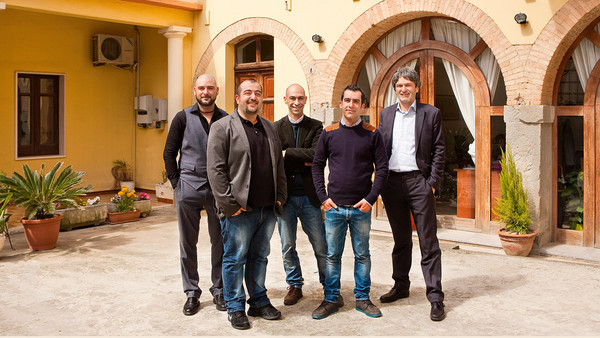
Sardex’s founders outside their office in Serramanna, Sardinia
©Alessandro Toscano

Sardex’s founders outside their office in Serramanna, Sardinia
Across the island of Sardinia there are more than 7,000 ancient towers built with large blocks of local stone. Known as nuraghi, they resemble giant beehives, jutting out across the landscape. Little is known about the nuraghi or their Bronze Age architects but almost every Sardinian I met had a theory about their purpose. Some told me that they were forts; others that they were residences, places of exchange, even communication beacons. “The amazing thing is that from every single nuragheyou see another nuraghe,” Carlo Mancosu, a 34-year-old Sardinian, told me. “Now imagine a system of communication with flames or light or mirrors. I think there existed a people in a network.”
It was this system, real or imagined, that inspired Mancosu and a group of childhood friends to found Sardinia’s first local currency: Sardex. Arts and humanities graduates with little financial experience, they built it from scratch in their home town of Serramanna as the island reeled from the financial crisis. Their hope was that the project would give them a job in the place where they had grown up. But six years later it has turned into a symbol of local action, spreading to create a new network of thousands of businesses. Together, they have traded nearly €31.3m in Sardex this year.
Serramanna sits just within the agricultural region of Medio Campidano, one of the poorest in Italy. When I visited, its piazza was full of old men drinking their coffee under the shade of Canary palms. Only the occasional roar of a jet engine from the nearby Nato base broke the silence. I met four of the currency’s five founders in their office, an old farmhouse in the town. On the wall was a sign in Sardinian and Italian: “Don’t complain.” Giuseppe Littera, another founder, told me that it was intended for his grandmother, who owns the farmhouse. “I love my grandmother [but] she’s still complaining about the Nato base because they took 10 plants from the best olive field their family had.”
Now in their early to mid-thirties, the founders all grew up together in Serramanna. “I have traced my ancestry back 500 years,” Giuseppe told me proudly. “They didn’t have earlier records.”
They seemed a remarkably disparate group, fiercely debating local politics and the financial crisis. Giuseppe speaks rapidly, moving between Italian and English. Gabriele, his younger brother, is more restrained, carefully balancing his words. Then there’s Mancosu, the most confident of the four. And Piero Sanna, a pragmatic amateur gold trader, whose financial experience initially set him apart from the others.
Life in their home town can seem idyllic, with its old church, public spaces and faded murals. But the four presented a different image. “Youth unemployment is at 50 per cent,” Giuseppe said. “The factories are in a state of crisis. Anyone with minimal linguistic abilities escapes to London or Berlin."
One of the stone towers, or 'nuraghi', found across the island
©Alessandro Toscano

One of the stone towers, or ‘nuraghi’, found across the island
In the 1960s, planners in Rome decided that the future of Sardinia — an island of miners, shepherds and farmers — lay in industrial production. Countless petrochemical plants, factories and refineries were built as part of the state-led Piano di rinascita (Plan for Rebirth). When I asked Sardex’s founders about the town’s problems, they would often repeat the phrase with a tinge of sarcasm. “Bring hell to paradise,” Mancosu said, “and they call it plan for rebirth.” The island’s nascent petrochemical industry, knocked off course by the 1973 Opec price rise, proved unable to compete in the international market. As the plants declined, thousands were laid off. “We had to face, year by year, an emergency in these industries,” said Stefano Usai, an economist at Crenos, a Sardinian research institute. “It is a heavy inheritance.”
Then, in 2008, another wave hit the island: the financial crisis. “Here, 2,000 miles away [from Lehman Brothers], banks stopped lending anything really,” Giuseppe told me. “People stopped going to ask for a loan.” Unable to secure credit, companies started to fold, swelling the ranks of the jobless. “In Serramanna we have a suicide problem.”
A Sardex agent
©Alessandro Toscano

A Sardex agent
At the heart of the financial crisis, explained Giuseppe, was a contradiction: its causes remained distant but its effects were local. “What does the economic system of Sardinia have to do with the mismanagement of Wall Street or London?” he said. The island’s companies still had the potential to produce goods and services; stock was sitting in warehouses and people were able to work. If this was a financial crisis, he began to think, then perhaps there was a financial solution. “There was no other option,” he said, “but to let companies create their own money.”
For at least 150 years, business people, utopians, social reformers and eccentrics have tried to introduce local currencies, often in response to money scarcity. Their creations have taken an array of different forms, such as credit systems, time banks or paper money, and ranged from the ingenious to the absurd. Many have been shortlived — but others have outlasted the conditions that brought them into existence.
Among the most successful is the Swiss WIR, which first appeared during the Great Depression. In 1934, a network of Swiss businesses decided to build a system of mutual credit allowing them to trade without relying wholly on the Swiss franc. The currency proved remarkably resilient, especially during periods of economic downturn. Although it has changed significantly since its inception, the WIR is still going strong and has about 45,000 members.
The office, a converted farmhouse
©Alessandro Toscano

The office, a converted farmhouse
“For his different purposes,” wrote the British economist EF Schumacher, “man needs many different structures, both small ones and large ones, some exclusive and some comprehensive.” For some, local currencies are a financial response to this human need and one that has a strong precedent through history. “The permanent feature of monetary systems in Europe throughout the period from Charlemagne to Napoleon — for a good millennium — [is] a distinction between different moneys for different purposes,” says Luca Fantacci, an economist and historian at Bocconi University in Milan.
Map: Sardinia in Italy
Sardex began as a small, unlikely idea while Giuseppe was a student in Leeds. In 2006 he read about WIR, the Swiss complementary currency, and became obsessed by the possibility of bringing something similar to Serramanna. “When I went to England and I was still studying, I was kind of trying very hard to find meaning in life. And when I discovered the WIR thing — that was like, OK, it’s a battle worth fighting. The other option is: let’s wait for systemic worldwide change.” He discussed the idea over Skype with Mancosu, Gabriele Littera, Sanna and Franco Contu, another founding member and friend, and they began designing a new local electronic currency whose name, Sardex, left no mystery as to its origins.
And so the group of arts students planned a new currency for their island. It seemed absurd: they had little financial or IT experience, no MBAs and no investor, only the outline of an idea. “We said: ‘We are here, the companies are here. [We can do this] without inconveniencing Brussels, Rome or New York,’” Giuseppe told me.
To build Sardex, they turned to financial history, drawing on studies of ancient credit systems, the Swiss WIR and John Maynard Keynes’s proposal for an International Clearing Union at Bretton Woods, a version of which was implemented as the European Payments Union (1950-58). There was logic in this approach; for if the financial crisis proved anything, it was that the history of finance is not linear. “There’s no reason to think that financial markets are more progressive than the financial institutions of the Renaissance,” says Massimo Amato, an economist and historian at Bocconi. “Common sense is never outdated.”
The Mulargia Lake in southern Sardinia
©Alessandro Toscano

The Mulargia Lake in southern Sardinia
While Sardex’s founders borrowed from history, they were not beholden to tradition. In a recent paper, Paolo Dini of the London School of Economics writes that, “Sardex has institutional characteristics that make it almost unique among the thousands of examples of CCs [complementary currencies] that have existed throughout human history and that still exist in almost every country in the world.”
To understand how Sardex works, you have to abandon much of what you may think you know about money. There is no bank that prints Sardex notes; no algorithm that generates Sardex digital coins. Instead, it functions as a system of mutual credit: each firm begins at zero, earning the digital currency — equivalent to but non-exchangeable with the euro — as it offers goods or services to others in the network. Companies may go into debt but only up to a certain limit, determined by what they can offer the other participating firms. Crucially, there is no interest on Sardex; it functions purely as a means of exchange. “[In the circuit] you have a debtor who does not see their debt increase but finds creditors who want to spend,” Gabriele told me. “This should be a natural part of the market.”
When Sardex was first explained to me, I found it easiest to think of it as a simple portrait of human relationships. “Money becomes information,” said Mancosu. “But, above all, money [here] is a system of rights and duties. From the moment that I take from a community — as is the case in Sardex — I am in debt towards that community; when I settle that debt with the community, I have given what I have received. It’s a beautiful thing.”
The founders, from left: Gabriele Littera, Piero Sanna, Carlo Mancuso, Giuseppe Littera and Franco Contu
©Alessandro Toscano

The founders, from left: Gabriele Littera, Piero Sanna, Carlo Mancuso, Giuseppe Littera and Franco Contu
The root of the word finance is the Latin finis, “end”. For Amato and Fantacci, the two Italian economic historians, Sardex’s simplicity reflects finance’s etymology and its true purpose: it allows a creditor and debtor to come together, make a payment and part ways, ending their relationship. Nothing could be further from the unsustainable repackaged debt, the system of delayed payments, which resulted in the collapse of the banking system in 2008. “[Sardex] is money that serves an end,” Giuseppe told me. “And once that end has been reached — it has done its work.”
At the heart of Sardex are its administrators. Using a centralised system, they carefully track member firms’ transactions, occasionally nudging the network to ensure its stability. Did they not, I wondered, resemble those central bankers from whom they had sought to distance themselves? “Sardex is voluntary,” Giuseppe replied. “We have no guns and we have no power.”
It proved easier to design Sardex’s system than persuade firms to adopt it. After registering the company in Serramanna in July 2009, the founders began to approach local businesses with their idea. As a group, they must have presented a curious sight: not one typically associated with financial professionals. Hundreds of firms in Sardinia rejected their proposals; after all, they needed euros to pay suppliers, not an invented currency overseen by a group of idealists. “It was a war,” recalled Mancosu. “They looked at us if we were from outer space.”
Then, at the beginning of 2010, the founders had a breakthrough: a local businessman, believing he was joining an established network, signed up. “We explained it to him,” recalled Mancosu. “And, for the first time, he said: ‘Great. That’s fantastic. Who else is in?’ ‘Just you,’ we said. ‘But we will grow.’ ”


Sardex: how does it work?
● Sardex is an electronic system of mutual credit for Sardinian companies. Lawyers, accountants, media companies, shops, hotels and utility companies all use it.
● To be eligible, a firm must have spare goods or services to offer to participating firms and be willing to make purchases within the network using Sardex.
● All firms begin with zero Sardex, earning the electronic currency as they transact with other members.
● Firms can go into Sardex debt but only up to a limit set by the administrators. No interest is charged on balances.
● Transactions of less than €1,000 must be carried out in Sardex. Larger transactions can use Sardex with euros.
● All transactions are tracked via a centralised system in Serramanna. VAT on transactions is paid in euros.
● Members are charged an annual fee according to size, ranging from €200 to €3,000.
And slowly Sardex did. High-street shops, hotels, media firms, accountants, dentists and restaurants all began to enter the network. By accepting payment in the currency, companies found that they could dispose of unused stock; cash-strapped firms could buy goods and services that they couldn’t otherwise afford. Lacking resources, the founders relied on charm, tenacity and, above all, their connection with the local area to persuade businesses to join. “Human relations have always been at the heart of our project,” Gabriele told me. “It has never been possible to sign up to the circuit via the internet.”
By the end of 2010, Sardex had a total of 237 members and a modest transaction volume of just over €300,000. It was still a struggle to survive, they recall. Initially the team relied on their families for support, later charging companies a small membership fee based on their size. And then, in 2011, they had a piece of luck: dPixel, a Milanese venture capital firm, intrigued by their idea, agreed to invest €150,000 in the company. “That was a real lifeline,” Giuseppe said.
 . . . 
Fifteen years ago, a retired law academic named Giacinto Auriti introduced his own paper money, the Simec, in Guardiagrele, a town in central Italy about the size of Serramanna. A wealthy man, Auriti paid a local printer to produce the currency, distributing it to locals from his own palazzo in exchange for lire. For Auriti, the Simec was not just a local initiative but a front in his long-running campaign against central banks and their monopoly on money production. “Between me and the central banks there is a mortal struggle,” he told The New York Times in 2001. “There is no middle way.”
Serramanna, where youth unemployment is high
©Alessandro Toscano

Serramanna, where youth unemployment is high
Unlike Auriti, Sardex’s founders have always viewed their currency as complementary to the financial system; they are not waging war against the Bank of Italy. State-issued money remains central to Sardex: firms in its network may combine euros and Sardex when making payments; taxes on Sardex transactions must be paid in euros; and the value of Sardex itself is tied to the euro. “We developed the network to be politically agnostic,” Giuseppe told me. “We talk to everybody: we don’t give a shit if you are from the left, the right, the north, the south.”
Auriti did not win his struggle against the Bank of Italy. In 2000 the Italian financial police, the Guardia di Finanza, shut down his experiment. But Sardex continues to grow. Today around 2,900 businesses are using it, including some of Sardinia’s most established organisations: Tiscali, the telecommunications company, and L’Unione Sarda, one of the island’s main newspapers. Stripped of money’s function as a store of wealth, Sardex has circulated quickly; according to the founders’ figures, it has facilitated more than €30m of transactions this year and about €84m since it started.


Timeline
April 2010: first Sardex transaction
Idea inspired by network of nuraghi
December 2010: 237 company members
2011: venture capital firm dPixel agrees investment
October 2012: €5m credit transactions
€31m traded in Sardex this year
€84m credit transactions facilitated since 2010
Trials under way throughout Italy
“In our circuit, one credit circulates 12 times in a year,” Gabriele said. “No one keeps their [Sardex] credits stuck in their wallet.”
The prize for Sardex is now Sardinia’s biggest employer: the state. The team is currently proposing a scheme whereby the island’s regional government could join the network, disposing of its spare capacity, such as bus tickets or leases on property. The deputy governor of Sardinia, Raffaele Paci, is an economist who seems to represent the opposite of these young arts graduates who were so distrustful of mainstream economic thinking. “If we live in an ideal world then we do not need Sardex,” he told me. But he recognised that in this imperfect world the currency had a role to play. “In general, it’s a good experience that is helping a lot.”
Some six years after it started, Sardex still faces challenges. In an imperfect market, the network must be pushed and pulled to maintain its stability, placing great responsibility and influence in the hands of its administrators. Then there’s the question of cheating. A system that relies on trust, Sardex allows companies to go into unsecured debt, exposing the network to the risk that a member may rack up a negative balance and walk away. In practice it’s happened a few times, said Giuseppe, and the team now has several claims lodged in Italy’s notoriously slow court system. “It is our last-resort scenario,” he told me.
After meeting Sardex’s team, I took a walk around Serramanna to speak with local businesses. The owner of a local store showed me her online Sardex account, indicating her balance and all the firms with whom she could potentially transact. She had sold lingerie to companies in the network, earning Sardex, which she then used to pay her accountant. “It’s ingenious,” she said. “It makes the money circulate here [and] doesn’t allow it to leave the island. It creates a connection.”
The model has already spread in Italy and there are reportedly trials under way to create local currencies in Veneto, Piedmont, Emilia Romagna, Marche, Lazio and Sicily. Last year Giuseppe travelled to Greece to share his knowledge with local currency organisers. Yet his advice to them was less about financial models, credit systems and software than relationships and trust. “Focus on the impact you can have, work every day . . . and try to build communities where there are none,” he told them. “[In Sardinia] the social fabric was destroyed. And we started knitting.”
Edward Posnett is working on ‘Harvest’, a book about commodities, trade and the natural world, to be published by Bodley Head/Viking Penguin, 2017
Photographs: Alessandro Toscano
Source: Dini, P, Van Der Graaf, S and Passani, A (2015). D2.3.d1: Socio-economic Framework for Bold Stakeholders, openlaws.eu deliverable, European Commission